What Is the Best Pet-Friendly Disinfectant? A Guide for Homes with Dogs and Cats
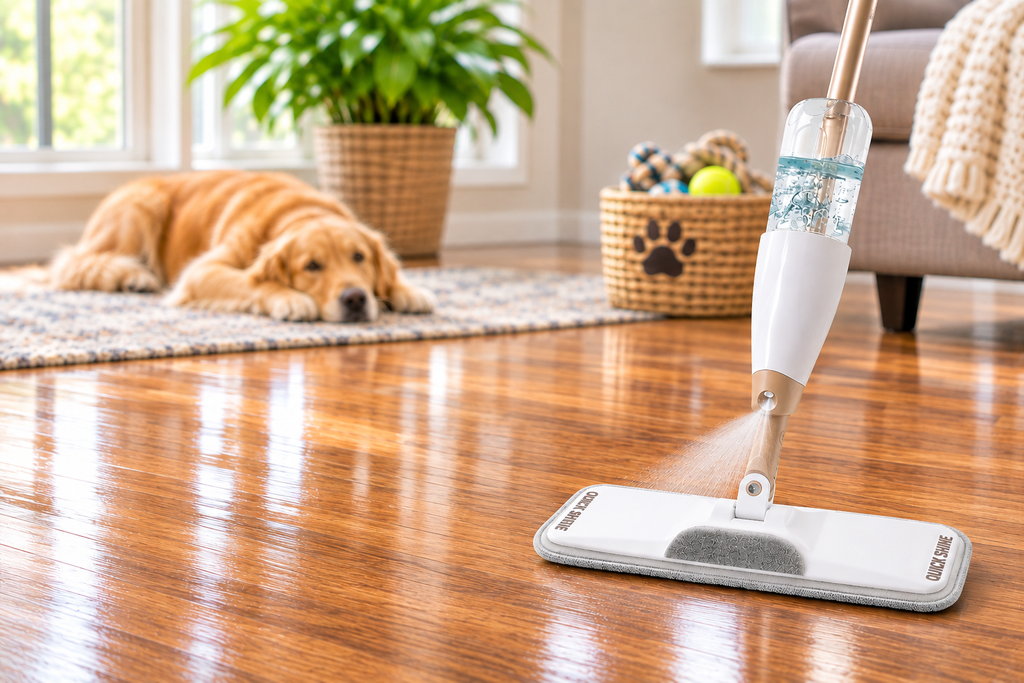
What is the best pet-friendly disinfectant for a home with dogs and cats? The answer depends on what you’re cleaning, whether you need to remove everyday dirt or kill germs, and how you use the product around your pets.
From muddy paw prints and food spills to pet accidents and everyday germs, keeping floors clean is an important part of maintaining a comfortable home.
But not every cleaning product is appropriate for every surface, and not every floor cleaner is a disinfectant.
The good news? With the right products and a few simple precautions, you can maintain clean floors while minimizing unnecessary exposure to cleaning chemicals.
In this guide, we’ll explain how to choose a disinfectant for a home with pets, what ingredients and claims to look for, and how Quick Shine® floor care products can fit into your cleaning routine.
What Is the Best Pet-Friendly Disinfectant?
The best disinfectant for a household with pets is an EPA-registered disinfectant labeled for the surface you’re treating, used exactly according to its directions.
A disinfectant should identify the germs it is designed to kill and provide instructions for proper application, contact time, and any required rinsing.
However, it’s important to understand that pet-friendly does not mean a product is harmless if swallowed, inhaled, or used incorrectly.
Even products intended for use in households with pets require appropriate precautions.
When choosing a disinfectant, consider:
- EPA registration: Look for a disinfectant registered with the U.S. Environmental Protection Agency.
- Surface compatibility: Confirm that the product is appropriate for your flooring material.
- Contact time: Follow the label’s required wet contact time for disinfection.
- Pet precautions: Check whether pets must remain away from treated surfaces until dry or until additional steps are completed.
- Ventilation: Follow directions for ventilation during and after cleaning.
For routine dirt, footprints, and everyday messes, disinfection may not be necessary. A floor cleaner formulated for your flooring can often accomplish the task.
What’s the Difference Between Cleaning and Disinfecting?
Although these terms are frequently used interchangeably, cleaning and disinfecting serve different purposes.
Cleaning Removes Dirt and Grime
Cleaning physically removes dirt, debris, and other unwanted substances from surfaces.
For example, Quick Shine® Multi-Surface Floor Cleaner is designed to clean everyday dirt and grime from compatible hard-surface floors.
Its EPA Safer Choice Certified, pH-neutral, rinse-free formula is powered by baking soda.
Routine cleaning is an important part of maintaining floors in homes with pets.
Disinfecting Kills Specific Germs
Disinfecting involves using an EPA-registered product according to its label to kill specified microorganisms on treated surfaces.
A disinfectant must remain on the surface for the required contact time to achieve its labeled effectiveness.
Important: A floor cleaner should not be described as a disinfectant unless it carries the appropriate registration and labeled disinfecting claims.
When Should You Disinfect Your Floors?
Routine floor cleaning is generally appropriate for everyday dust, dirt, paw prints, and food spills.
Disinfection may be appropriate when there is a specific concern about infectious germs, such as certain illness-related contamination.
For pet accidents involving feces or vomit, follow appropriate cleanup and disinfection guidance for the situation, using products compatible with the flooring and following label precautions.
Why Is Choosing the Right Cleaning Product Important for Pets?
Dogs and cats spend considerable time close to the floor.
They walk across freshly cleaned surfaces, lie on flooring, and may lick their paws after contact with cleaning residues.
That makes proper product selection and application particularly important.
Potential problems from inappropriate cleaning product exposure can include:
- Skin or paw irritation
- Eye irritation
- Respiratory irritation
- Digestive problems if a product is swallowed
- Reactions to certain concentrated fragrances or chemicals
The risk depends on the ingredients, concentration, exposure, and individual animal.
The goal isn’t to eliminate every cleaning chemical from your home. It’s to select appropriate products and use them responsibly.
For additional guidance, read our article on floor cleaners that may be unsafe for pets.
What Cleaning Ingredients Should Pet Owners Look For?
Rather than relying on terms such as “natural” or “chemical-free,” look for meaningful product information and recognized certifications.
EPA Safer Choice Certified Cleaners
The EPA Safer Choice program evaluates product ingredients against criteria addressing human health and environmental considerations.
Products carrying the Safer Choice label meet the program’s requirements for their product category.
Quick Shine offers EPA Safer Choice Certified floor cleaning products, including:
- Quick Shine® Pet Hard Surface Floor Cleaner
- Quick Shine® Multi-Surface Floor Cleaner
- Quick Shine® Hardwood Floor Cleaner
These cleaners can help address everyday floor cleaning needs in homes with pets.
EPA Safer Choice certification does not mean a cleaner is an EPA-registered disinfectant or that it is harmless under every exposure condition.
Baking Soda-Powered Floor Cleaners
Baking soda is commonly used in household cleaning because of its cleaning and deodorizing properties.
Quick Shine® Pet Hard Surface Floor Cleaner features a formula powered by baking soda, designed for everyday hard-surface floor cleaning.
Quick Shine Multi-Surface Floor Cleaner is also powered by baking soda.
These products are floor cleaners, not substitutes for disinfectants when germ-killing is required.
pH-Neutral Floor Cleaners
For compatible finished flooring, pH-neutral cleaners can be a practical choice for routine maintenance.
Quick Shine Hardwood Floor Cleaner and Multi-Surface Floor Cleaner feature pH-neutral formulas designed for everyday cleaning.
Always check your flooring manufacturer’s recommendations before applying any product.
Are Vinegar, Essential Oils, and Hydrogen Peroxide Pet-Friendly Disinfectants?
Many online cleaning tips recommend household ingredients as alternatives to commercial disinfectants.
However, homemade cleaning solutions are not necessarily appropriate for pets or finished flooring.
Is Vinegar a Disinfectant?
Vinegar can help with certain household cleaning tasks, but ordinary household vinegar is not an EPA-registered disinfectant.
It should not be relied upon to disinfect floors when control of specific germs is necessary.
Its acidity may also affect some flooring finishes.
Are Essential Oils Safe Around Dogs and Cats?
Certain essential oils can be harmful to pets, particularly when concentrated, swallowed, inhaled, or absorbed through the skin.
Cats may be especially sensitive to some essential oil exposures.
Avoid adding essential oils to homemade floor cleaners without veterinary guidance.
A pleasant fragrance does not establish that a cleaning product is appropriate for pets.
Can Hydrogen Peroxide Disinfect Floors?
Hydrogen peroxide is an ingredient in some EPA-registered disinfectants.
However, household hydrogen peroxide should not automatically be treated as an approved floor disinfectant.
Its effectiveness and suitability depend on the formulation, concentration, surface, and directions.
It may also discolor or damage certain flooring materials.
What About Bleach and Ammonia?
Bleach-based disinfectants can be effective when properly formulated and used according to their labels, but they require careful handling and appropriate pet precautions.
Ammonia-containing products may cause irritation and are not appropriate for every surface.
Never mix bleach with ammonia, vinegar, or other cleaning products. Dangerous gases can form.
Best Quick Shine Floor Cleaners for Homes with Pets
Different pet-related messes require different cleaning solutions.
Quick Shine offers several options for routine floor cleaning, depending on your flooring type and cleaning needs.
1. Quick Shine® Pet Hard Surface Floor Cleaner
Best for: Everyday floor cleaning in homes with pets
Quick Shine Pet Hard Surface Floor Cleaner is a convenient option for pet households dealing with everyday dirt and hard-surface floor messes.
Product highlights:
- EPA Safer Choice Certified
- PFAS Free
- Powered by Baking Soda
- Formulated for everyday hard-surface floor cleaning
- Convenient for regular floor maintenance
This cleaner is a useful choice for routine cleaning in homes with dogs and cats.
For pet urine accidents, promptly remove the liquid and follow the product’s label directions. If urine has penetrated the flooring or damaged an applied finish, additional treatment may be necessary.
2. Quick Shine® Multi-Surface Floor Cleaner
Best for: Routine cleaning of compatible hard-surface floors
Quick Shine Multi-Surface Floor Cleaner is designed to remove everyday dirt and grime from a variety of compatible hard-surface flooring materials.
Product highlights:
- EPA Safer Choice Certified
- PFAS Free
- Powered by Baking Soda
- pH Neutral
- Rinse-Free Formula
It’s a practical option for households looking for one cleaner for multiple compatible flooring surfaces.
3. Quick Shine® Hardwood Floor Cleaner
Best for: Everyday cleaning of finished hardwood floors
Hardwood floors require special attention because excessive moisture and inappropriate cleaning products can damage their protective finish.
Quick Shine Hardwood Floor Cleaner features:
- EPA Safer Choice Certification
- PFAS Free formulation
- pH-neutral cleaning
- Rinse-free convenience
- A formula designed for compatible finished hardwood floors
For more information, read our guide on how to clean hardwood floors.
Remember: These Quick Shine floor cleaners are intended for cleaning. Do not substitute them for an EPA-registered disinfectant when disinfection is required.
How Do You Clean Pet Urine from Hardwood Floors?
Pet urine accidents require prompt attention because moisture can penetrate flooring seams or affect protective finishes.
Step 1: Blot the Accident Immediately
Use a clean, absorbent cloth to remove as much liquid as possible.
Avoid rubbing the urine across the floor.
Step 2: Clean the Affected Surface
Use a hardwood-compatible floor cleaner according to its label instructions.
Avoid soaking the flooring or allowing liquid to collect between boards.
Step 3: Dry the Floor Completely
Remove remaining moisture and allow the area to dry.
Step 4: Inspect for Stains or Finish Damage
If the floor has been treated with Quick Shine Multi-Surface Floor Finish or Hardwood Floor Luster, pet urine may affect the applied polish layer.
Ammonia associated with pet urine can soften the polish and leave cloudy or discolored spots.
When the damage is confined to the Quick Shine polish layer, Quick Shine® Concentrated Deep Cleaner can be used to spot-treat and remove the affected coating according to label directions.
This is different from removing a stain that has penetrated the actual hardwood.
If discoloration remains in the wood beneath the coating, professional restoration may be necessary.
For detailed instructions, explore our guide on removing stains from hardwood floors.
How Do You Use Disinfectants Around Pets?
Even when a disinfectant is appropriate for a household with pets, proper use is essential.
1. Read the Entire Product Label
Check the disinfectant’s directions for application, dilution, contact time, surface compatibility, and any required rinsing.
2. Keep Pets Away During Application
Move dogs, cats, and other animals away from the area being treated.
Prevent access to open containers, wet surfaces, and cleaning equipment.
3. Follow the Required Contact Time
Disinfectants must remain wet for the time specified on the label to achieve their labeled germ-killing effectiveness.
Wiping a product away too quickly may prevent it from working as intended.
4. Rinse When Required
Some disinfectants require rinsing after the contact time, particularly on surfaces that may contact food or animals.
Follow the specific label rather than assuming every disinfectant is rinse-free.
5. Allow Floors to Dry Completely
Keep pets away until the treated surface has dried and any additional label requirements have been met.
6. Store Cleaning Products Securely
Keep disinfectants, concentrates, and other household cleaning products in their original containers and out of pets’ reach.
If you suspect your pet has been exposed to a cleaning product and is showing symptoms, contact your veterinarian or an animal poison control service promptly.
How Often Should You Clean Floors When You Have Pets?
The ideal cleaning schedule depends on the number of pets, their activity levels, your flooring type, and how much dirt enters your home.
For many pet households, a simple routine works well.
Daily or as needed: Remove pet hair, dust, food crumbs, and visible dirt. Blot accidents immediately.
Several times per week: Clean frequently used areas when dirt or paw prints accumulate.
Weekly or as needed: Mop compatible hard-surface floors using an appropriate floor cleaner.
When disinfection is necessary: Follow the directions for an EPA-registered disinfectant suitable for the affected surface and situation.
Cleaning frequency should reflect your household’s needs rather than an assumption that every floor requires daily disinfection.
Frequently Asked Questions About Pet-Friendly Disinfectants
What is the best pet-friendly disinfectant for floors?
Choose an EPA-registered disinfectant labeled for your flooring surface and follow all directions, including contact time, rinsing, and pet precautions. No disinfectant should be assumed harmless to pets under every condition.
Is Quick Shine Pet Hard Surface Floor Cleaner a disinfectant?
Quick Shine Pet Hard Surface Floor Cleaner is designed for routine hard-surface floor cleaning. It should not be treated as a disinfectant unless the specific product label carries EPA-registered disinfecting claims.
What is the difference between a pet-friendly cleaner and a disinfectant?
A cleaner removes dirt and grime. An EPA-registered disinfectant is designed to kill specified germs when used according to its label. A product can be useful for routine cleaning without being a disinfectant.
Are EPA Safer Choice Certified cleaners appropriate for homes with pets?
EPA Safer Choice Certified products meet the program’s ingredient and product criteria. They can be useful options for households with pets when used as directed, but certification does not mean a product is harmless or suitable for every animal or surface.
Is vinegar a pet-friendly disinfectant?
Household vinegar is not an EPA-registered disinfectant and should not be relied upon for disinfecting floors. Its acidity may also affect certain flooring finishes.
Can essential oils be used in homemade floor cleaners around pets?
Some essential oils can be harmful to dogs and cats, especially in concentrated forms. Avoid adding essential oils to homemade cleaning solutions without veterinary guidance.
How long should pets stay off freshly disinfected floors?
Follow the disinfectant’s label instructions. Keep pets away during application and until the surface is completely dry and any required rinsing or other precautions have been completed.
Can pet urine damage Quick Shine Floor Finish?
Yes. Ammonia associated with pet urine can soften or discolor an applied Quick Shine polish layer. Quick Shine Concentrated Deep Cleaner can be used to spot-treat and remove affected Quick Shine polish according to label directions, provided the underlying flooring is compatible.
Do you need to disinfect floors every day when you have pets?
Not necessarily. Routine cleaning is generally appropriate for everyday dirt, pet hair, and paw prints. Disinfection is most useful when there is a specific reason to address infectious germs.
Final Thoughts: Choosing the Best Pet-Friendly Disinfectant
Finding the best pet-friendly disinfectant starts with understanding what your floors actually need.
Everyday pet hair, muddy paws, and routine dirt can often be addressed with a floor cleaner formulated for your flooring material.
When disinfection is necessary, choose an EPA-registered disinfectant and follow its directions carefully, including precautions for pets.
For everyday floor maintenance, Quick Shine® Pet Hard Surface Floor Cleaner, Multi-Surface Floor Cleaner, and Hardwood Floor Cleaner offer EPA Safer Choice Certified cleaning options for compatible surfaces.
With the right products and a consistent cleaning routine, you can maintain beautiful floors while taking thoughtful precautions for the pets who share your home.
Explore the complete collection of Quick Shine floor care products at QuickShineFloors.com.